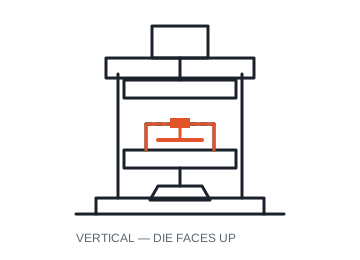
On a horizontal machine the die parting line is vertical. Anything placed in the cavity falls out before the die closes. On a vertical machine the parting line is horizontal — the cavity is a bowl facing upwards — so inserts stay where they are put, the die closes over them, and the casting forms around them.
That single geometric difference is the whole commercial case for this series. If the part has no insert, a horizontal machine will usually be faster and cheaper. If it has one, vertical is the only practical answer.
| Model | Clamping force | Alloys | Note |
|---|---|---|---|
| KSV-130 | 130 T | Zinc, magnesium, aluminium | Most common size for cable and hook work |
| KSV-160 | 160 T | Zinc, magnesium, aluminium | Larger platen for multi-cavity dies |
| KSV-200 | 200 T | Zinc, magnesium, aluminium | — |
| KSV-250 | 250 T | Zinc, magnesium, aluminium | — |
| KSV-300 | 300 T | Zinc, magnesium, aluminium | — |
| KSV-400 | 400 T | Zinc, magnesium, aluminium | Large inserts, deep draws |
The standard machine injects at the centre of the fixed die. An upgraded version injects at the die parting line, which gives a shorter, straighter flow path and better filling on awkward geometries. Tell us which one your die needs — it changes the platen and the nozzle arrangement.
Reference figures for KSV-130. Confirm against the drawing for your order — platen and shot configuration can be adapted.